Strategic Security Success with NetSPI’s New Threat Modeling Solution

Companies are constantly working to innovate. Updates are made to existing solutions, new solutions are launched, processes are refined, new technologies are implemented, etc. and as these changes are made it is normal for new threats to be introduced. The companies take on the risks and responsibilities of new system attack vectors created by these choices. It is critical that companies review these threats, ideally early in the planning phase, but also as an on-going practice throughout the product lifecycle to allow for information-based decision making with all needed data.
NetSPI’s new Threat Modeling service takes a holistic approach to identifying potential threats to your company’s systems and applications. Leveraging a proprietary methodology developed from over 20 years of hands-on penetration testing experience, as well as other widely adopted methodologies such as STRIDE, PASTA, and more, each engagement provides a detailed technical analysis that enables stakeholders to make strategic decisions based on prioritized vulnerabilities, enumerated attack scenarios, and customized remediation recommendations through a 6-step process:
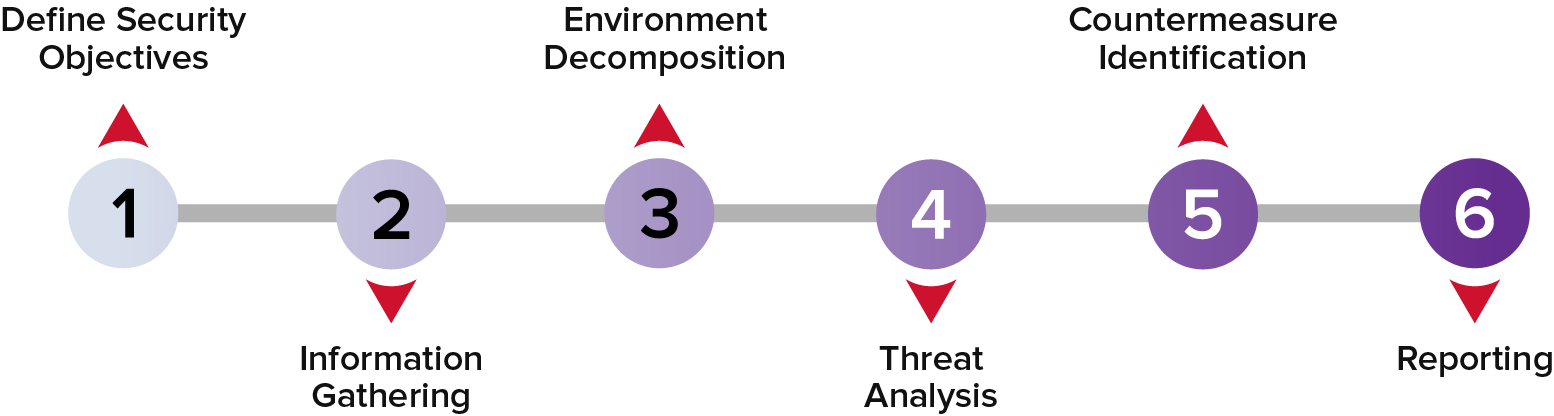
1. Define Security Objectives:
Establish specific security objectives for the engagement and prioritize in alignment with your company’s overall mission and risk tolerance.
2. Information Gathering:
NetSPI collects and reviews all available documentation. We also identify and interview system stakeholders such as: security personnel, developers, architects, business owners, project managers, operations staff, and more. These interviews are designed to provide information about both the architecture and context in which the system(s) function.
3. Environment Decomposition:
We build a component diagram of the most relevant deployment models and information flows between system components, then work to enumerate the system components and trust zones within the environment.
4. Threat Analysis:
Then, we develop a threat analysis based on the assets and system environment. Leveraging NetSPI’s extensive threat library, along with the client-provided information, we enumerate threats, classify severity, define attack scenarios, and identify additional security measurements that can be implemented based on business risks and organizational goals.
5. Countermeasure Identification:
We produce a threat traceability matrix by enumerating actions, devices, procedures, and techniques that prevent or mitigate threats to assets and system components.
6. Reporting:
Lastly, we produce a threat traceability matrix, mapping threats and threat scenarios to their trust zones, components, assets, and controls, and providing a summary of insufficient security controls and related threats.
If you would like to learn more about our Threat Modeling solution, check out our data sheet, or contact us for a demo.
This blog post is a part of our offensive security solutions update series. Stay tuned for additional innovations within Resolve (PTaaS), ASM (Attack Surface Management), and BAS (Breach and Attack Simulation).
Read past solutions update blogs:
Explore More Blog Posts

Securing Web Applications: The Importance of OWASP Top 10 in Pentesting
Learn how the OWASP Top 10 helps secure web applications by identifying critical vulnerabilities and guiding effective penetration testing practices.

How Secure Are Your SaaS Applications? Pentesting for SaaS Providers
Proactive SaaS pentesting protects data, ensures compliance, and builds trust. Learn best practices for securing APIs and cloud apps.

NetSPI Celebrates Our 2025 Partners of the Year
Congratulations to NetSPI’s 2025 Partner of the Year Recipients Stratascale, Defy Security, VLCM, BlackLake Security, Consortium, Softcat, CDW UK, ConnexIT, and AWS.