
Web Application Pentesting
NetSPI’s web app pentesting reduces organizational risk and improves application security through our leading security experts manually testing your web applications with commercial, open source, and proprietary tools.
Industry Leading Web Application Pentesting
NetSPI evaluates the strength and resilience of authentication mechanisms, input validation, application logic, data exposures, API security, and more. In addition to comprehensive coverage of the OWASP Web App Top 10 Vulnerabilities, our experts deliver actionable guidance for remediating vulnerabilities and improving your web app security posture.
Comprehensive OWASP Web App Top 10 Coverage
Information Gathering
- App architecture & deployment model analysis
- Review of application inventory, API documentation, and technology stack
- Credential, role, environment scope validation
Testing & Evaluation
- Anonymous & Authenticated user testing
- Manual & automated vulnerability testing
- Workflow, business logic, data exposure
- Access control verification across user roles
Analysis & Reporting
- Business impact assessment
- Specific remediation guidance
- Technical verification evidence
- Executive summary & detailed context
 Authenticated User Testing
- Credentialed users by type
- Access to restricted functionality
 Anonymous User Testing
- Test application & System layers
- Multiple Scanners & Manual verification
Key Web App Pentesting Focus Areas
![]() 1 ) Authentication & Access Controls
1 ) Authentication & Access Controls
NetSPI evaluates the strength and resilience of authentication and authorization mechanisms that protect your web applications. This includes uncovering broken access controls, privilege escalation paths, weak session management, and flaws in multi-factor authentication implementations. Our testing identifies where users can gain unintended access to sensitive functionality or data.
![]() 2 ) Input Validation & Application Logic
2 ) Input Validation & Application Logic
Web applications are frequently targeted through unvalidated or improperly sanitized user inputs. NetSPI tests for injection risks alongside business logic flaws that attackers can abuse to manipulate workflows, bypass controls, or trigger unintended system behavior.
![]() 3 ) Data Exposure & Secure Communications
3 ) Data Exposure & Secure Communications
NetSPI evaluates encryption effectiveness, data handling practices, and exposure risks in APIs, session tokens, cookies, and storage mechanisms. Our experts identify insecure data flows, misconfigurations in TLS, and opportunities for attackers to intercept or extract protected data.
![]() 4 ) Application Architecture
4 ) Application Architecture
Modern web applications rely heavily on distributed components such as APIs, microservices, cloud services, and third-party integrations. NetSPI performs in-depth testing of these architectural elements to uncover insecure authentication flows, excessive permissions, misconfigured integrations.
![]() 5 ) API Security
5 ) API Security
NetSPI tests for configuration weaknesses across your web application’s API endpoints. We apply traditional and advanced techniques to identify injection vectors, broken object-level access controls, architectural weaknesses.
![]() Continuous Web Application Pentesting
Continuous Web Application Pentesting
NetSPI’s continuous web application penetration testing delivers ongoing testing to uncover authentication weaknesses, broken access controls, injection vulnerabilities, business logic flaws, and data exposure risks before attackers can exploit them. This continuous pentesting approach helps organizations stay ahead of vulnerabilities introduced through frequent releases, new features, and evolving threats rather than relying on a single point-in-time assessment.
- Continuously evaluating auth mechanisms, input validation, application logic, API security, and more.
- Detects misconfigurations, vulnerabilities, and exposed data across your web applications.
- Confirms risk with human validation, demonstrating how vulnerabilities can be combined.
- Delivers findings through a centralized platform with clear, actionable recommendations for remediation.


 Agentic MCP Platform Integrations
- By tapping into validated vulnerability data and engagement context, your agentic systems can utilize our MCP service to automate risk-based decisions and workflows.
- Integrate NetSPI data into broader security and IT workflows, allowing agents to automatically create tickets, enrich alerts, or update systems of record.
- Extend the reach of your security team by enabling your agents to handle repetitive analysis and coordination tasks across large volumes of NetSPI findings.
 NetSPI AI Powers Continuous Pentesting
- Unlike generic AI solutions, NetSPI’s AI is specifically designed to address the unique challenges of modern cybersecurity testing.
- AI accelerates data processing, reconnaissance, and pattern recognition. It allows us to continuously map your attack surface with incredible speed, freeing human experts to focus on high-impact strategic analysis.
- Each test expands our knowledge base. Every vulnerability discovered helps refine how we approach the next environment. And every new testing scenario strengthens our AI, making future engagements smarter, faster, and more comprehensive.


NetSPI doesn’t bolt AI onto existing scanners. Its systems are built around how LLMs actually reason, providing unprecedented depth and fidelity. It chains attacks, adapts mid-test, confirms findings and is grounded in decades of real-world pentesting data.
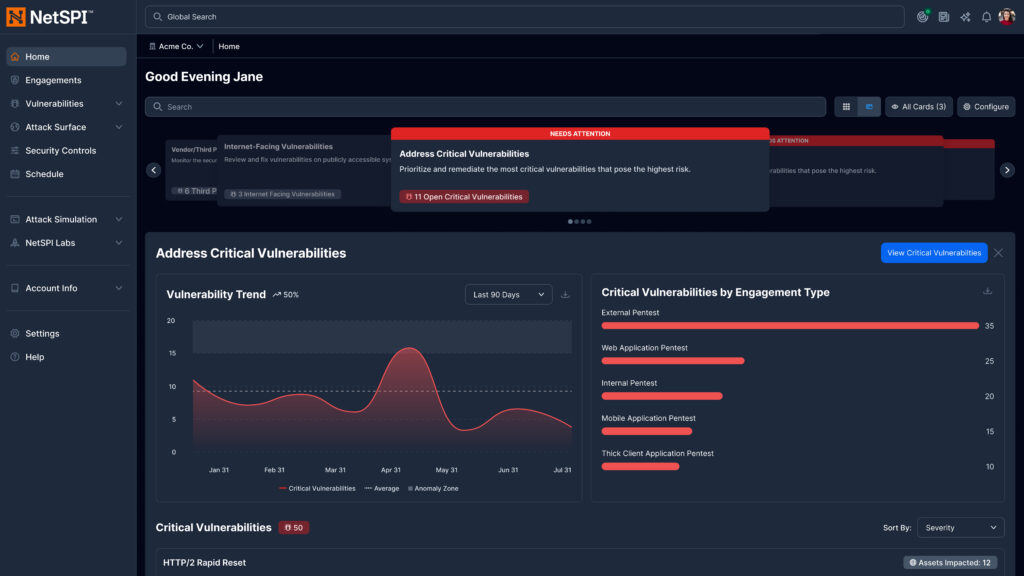
The New NetSPI Platform Experience
- Get answers to critical security questions faster, aligned to role and priorities
- Manage integrations, scans, and agents in one centralized workflow
- Accelerate detection, prioritization, and remediation across the attack surface
- Clearly demonstrate security outcomes to technical and executive stakeholders
“”
You Deserve The NetSPI Advantage
 Human-Led
- 350+ pentesters
- Employed, not outsourced
- Wide domain expertise
 AI-Accelerated
- Consistent quality
- Deep visibility
- Transparent results
 Modern Pentesting
- Use case driven
- Friction-free
- Built for today’s threats
Wep App – Featured Resources

How NetSPI won Mission Fed Credit Union’s business with its engagement, deliverables, and pricing model
In today’s cybersecurity landscape, application security is a top priority for Mission Fed Credit Union. See how NetSPI helps ensure security meets the highest standards.

Magic Bytes – Identifying Common File Formats at a Glance
Learn from the security experts at NetSPI how to identify common file formats at a glance when it comes to magic bytes. Read the blog.