Beautifying JSON in Burp

Most penetration testers know the pain of trying to view and modify an unparsed JSON string. For those that don’t, here’s a taste:
{"userId":1234,"username":"JakeReynolds","favorites":["Rubik's cubes","Doctor Who"],"dislikes":["Sushi","Vegetables"]}
When looking at thousands of these strings a day it is important for them to be well formatted and easily understandable. There currently exists a Burp Extension for beautifying JSON but it is written in Python, which requires Jython to be downloaded and added to Burp. There were also some issues with Jython and that extension not being as dependable as hoped. Due to those reasons we ported that functionality to Java which is run natively by Burp.
Java makes this extension one-click install, with support from Google’s GSON parser. The source code can be found on our Github as well as PortSwigger’s Github which includes updated build instructions.
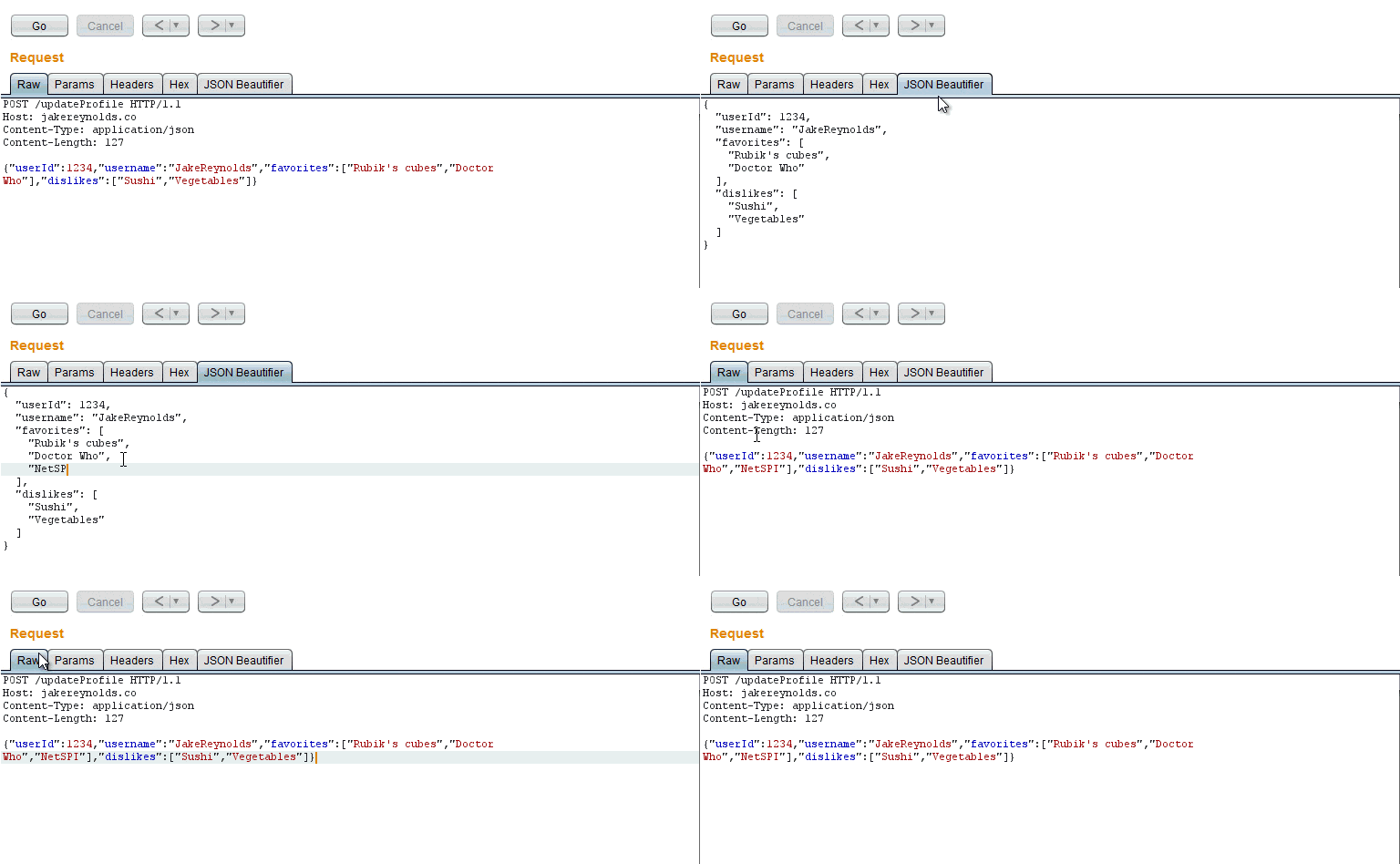
To install, simply go to Burp > Extender > BApp Store and select “JSON Beautifier”. The next time there is a JSON request in any of the Burp tabs there will be the option of “JSON Beautifier”. Any content modified in this tab will also be modified in the “Raw” tab. An example is below:
Thanks for checking out our Burp Extension! If you would like any features added feel free to create an issue on Github.
Explore More Blog Posts

You’ve Got (Graph) Mail – Leveraging Microsoft Graph API Change Notifications for Data Exfiltration
Discover how threat actors leverage Microsoft Graph API Change Notifications and Rich Notifications for stealthy post-exploitation data exfiltration of Outlook emails and Teams messages.
Authorization Differential Testing in Salesforce
NetSPI Salesforce expert Aussan explores how holding identity steady across UI API, GraphQL, and custom @AuraEnabled Apex methods reveals hidden authorization gaps.

PHP2Shell Unauthenticated RCE on PHP: CVE-2026-109618 & CVE-2026-109619
The PHP project has disclosed two critical vulnerabilities, CVE-2026-109618 and CVE-2026-109619, affecting all PHP installations that serve web requests. Both vulnerabilities carry a CVSS 4.0 score of 9.2 (Critical).