

Wireless Network Pentesting
Wireless devices can put your network at risk. NetSPI’s wireless network penetration testing identifies security issues and provides actionable recommendations on how to improve your wireless security.
Wireless Network Security Tests
Identify weaknesses, control bypass vulnerabilities, and rogue access points
Wireless network penetration testing with NetSPI looks at all three layers of the environment to catch security issues associated with the configuration, network management, applications, and data that are exposed to authorized and unauthorized wireless devices. Disgruntled employees, contractors, and external attackers can breach sensitive systems through wireless networks. NetSPI pentesters simulate the actions of a skilled adversary to identify wireless network security vulnerabilities that put your organization at risk.


5 Key Attack Scenarios of NetSPI Wireless Pentesting
Wireless networks extend your security perimeter beyond physical walls. NetSPI’s wireless penetration testing evaluates your Wi-Fi environment including enterprise SSIDs, guest networks, IoT/BYOD segments, connected endpoints, and more. These wireless penetration tests are often done from the perspective of an unauthorized attacker to ensure robust security posture and compliance.
![]() Offline PSK Hash Cracking & PMKID Recovery
Offline PSK Hash Cracking & PMKID Recovery
Attackers passively capture 4-way handshakes or PMKID identifiers from WPA/WPA2 PSK networks without user interaction, taking hashes offline for dictionary attacks to gain unauthorized network access.
- PMKID Hash & 4-Way Handshake Capture Analysis
- WPA2/WPA3 Enterprise & Personal (PSK/SAE) Auditing
![]() IoT & BYOD Network Lateral Movement
IoT & BYOD Network Lateral Movement
Weakly secured IoT or guest networks (e.g., ACME-BYOD, ACME-WLAN) allow attackers to breach isolated segments and pivot laterally into sensitive corporate or healthcare/ biomedical zones.
- IoT, Medical, & BYOD Network Isolation Verification
- VLAN Hopping & Segmentation Testing
![]() Rogue Access Point & Evil Twin Attacks
Rogue Access Point & Evil Twin Attacks
By setting up rogue APs matching corporate SSIDs (e.g. ACME-SECURE), attackers trick employee devices into connecting, enabling Man-In-The-Middle (MITM) credential harvesting and traffic manipulation.
- Man-In-The-Middle (MITM) Credential Harvesting
- Rogue (AP) Impersonation & Evil Twin Detection
![]() Captive Portal & Access Control
Captive Portal & Access Control
Attackers bypass guest network captive portals to spoof authenticated users, acquiring unmonitored internet and internal resource access.
- Access Control Bypass ( IP Spoofing, Tunneling)
- Guest Network Access Control Checks
![]() Unencrypted Traffic & Sniffing
Unencrypted Traffic & Sniffing
Open or legacy wireless networks expose unencrypted session data to passive sniffing, enabling attackers to harvest sensitive PII, credentials, and business communications from adjacent wireless clients.
- Wireless Intrusion Detection System Evasion
- Passive Sniffing Risk Assessment
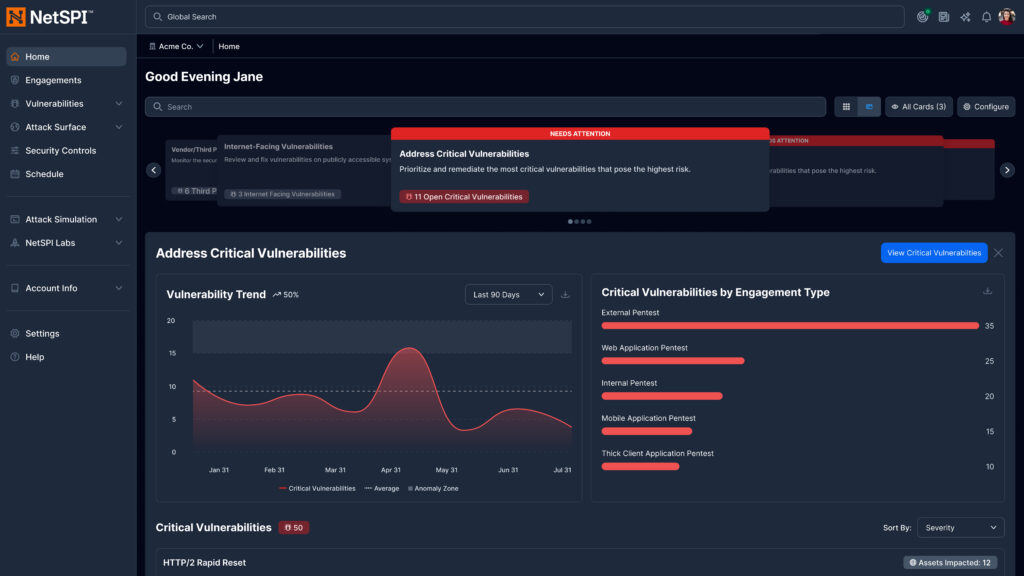
The New NetSPI Platform Experience
- Get answers to critical security questions faster, aligned to role and priorities
- Manage integrations, scans, and agents in one centralized workflow
- Accelerate detection, prioritization, and remediation across the attack surface
- Clearly demonstrate security outcomes to technical and executive stakeholders
“”
You Deserve The NetSPI Advantage
 Human-Led
- 350+ pentesters
- Employed, not outsourced
- Wide domain expertise
 AI-Accelerated
- Consistent quality
- Deep visibility
- Transparent results
 Modern Pentesting
- Use case driven
- Friction-free
- Built for today’s threats