
Action Message Format (AMF) is one of the communication protocols used to exchange messages between Flash client and server; the others are RTMP and XML. BurpAMFDSer is another Burp plugin that will deserialize/serialize AMF request and response to and from XML with the use of Xtream library (https://xstream.codehaus.org/). BurpAMFDSer also utilizes part of Kenneth Hill’s Jmeter source code for custom AMF deserialization (https://github.com/steeltomato/jmeter-amf).
How to run:
java -classpath burp.jar;burpAMFDser.jar;xstream-1.4.2.jar burp.StartBurp
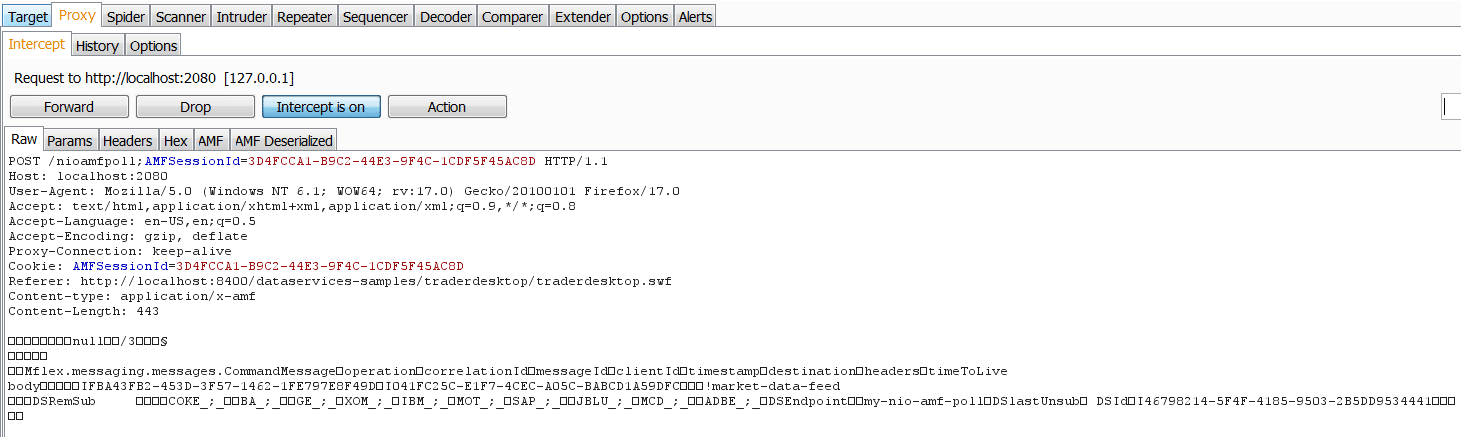
Sample serialized Request:
Sample deserialized Request:

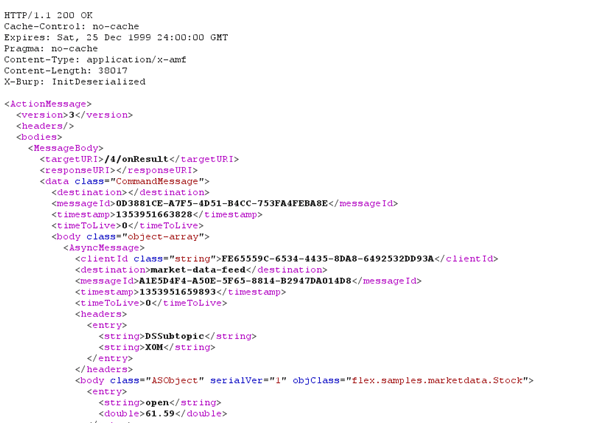
Sample deserialized Response:
Source code and executables are available at:
https://github.com/NetSPI/burp-plugins/tree/master/BurpAMFDSer/Old_APIs
The sample application in the screenshot is TraderDesktop, provided as part of ADEP Data Services for Java EE 4.6 and could be downloaded at: https://www.adobe.com/cfusion/tdrc/index.cfm?product=livecycle_dataservices
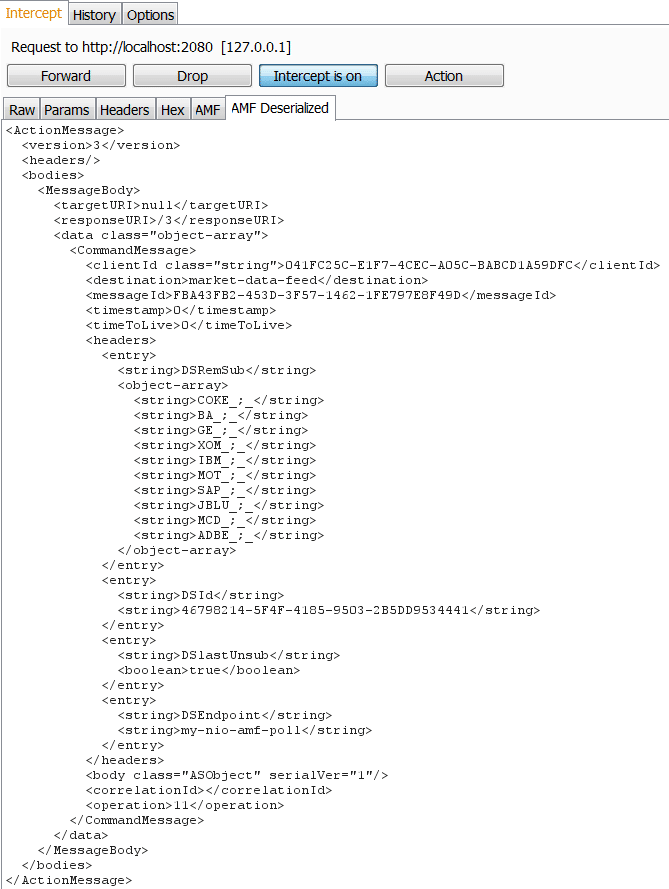
I’ve also developed a newer version of this plugin to be compatible with the new Burp Extender APIs (https://blog.portswigger.net/2012/12/draft-new-extensibility-api.html). Now you can modify AMF requests and responses in a separate tab.
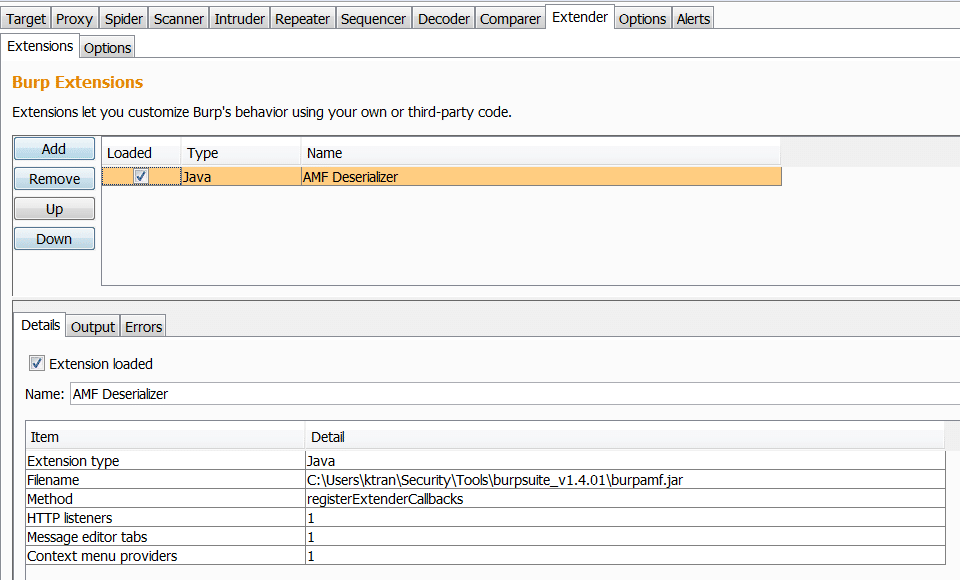
The new plugin can be loaded dynamically via Burp Extender:
Sample Request:
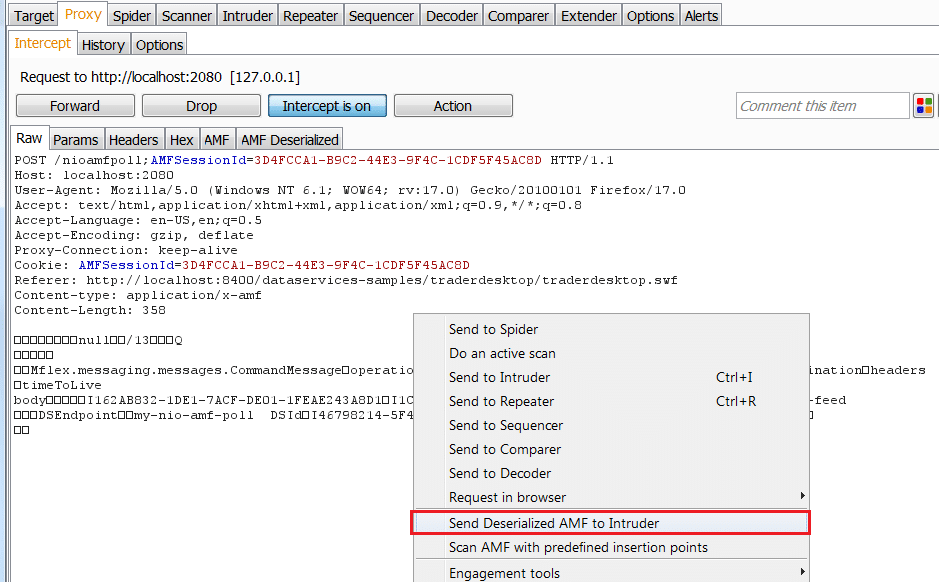
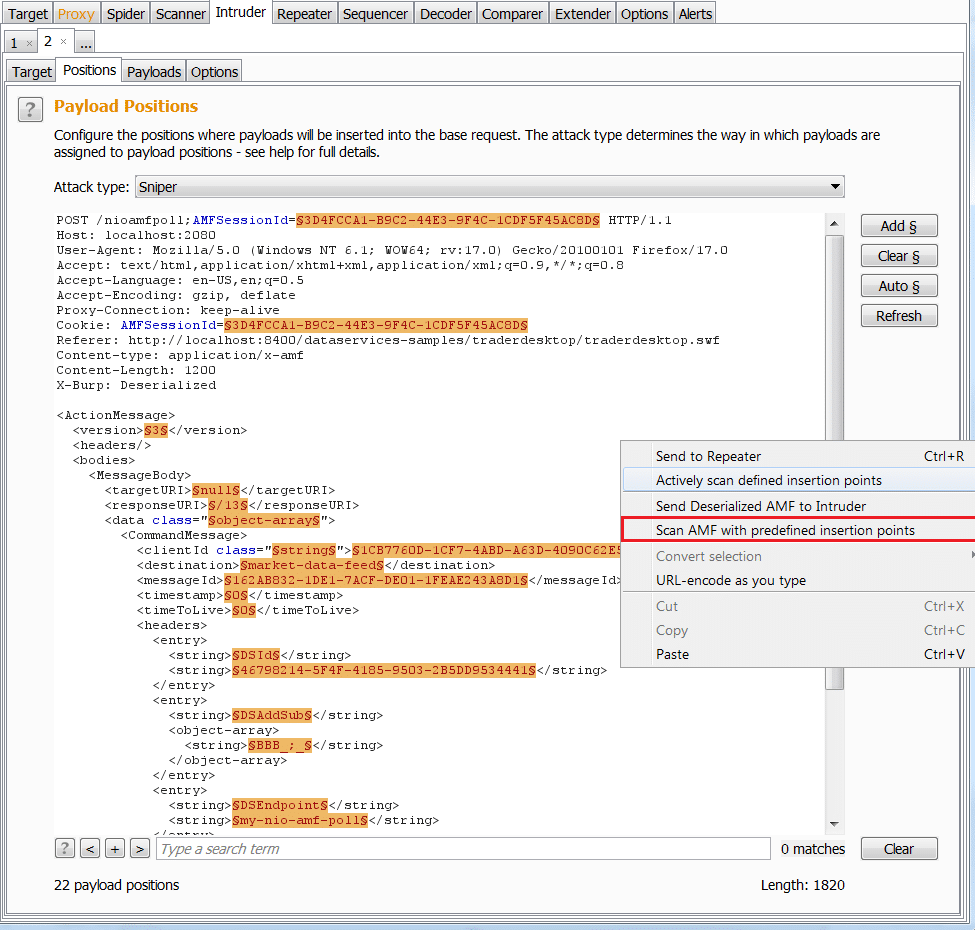
I also added 2 new menus to work with Intruder and Scanner (pro version only)
Send deserialized request to Intruder
Scan AMF (Pro version only)
Unfortunately, the new APIs are only available for Burp Suite Pro version 1.5.01 and later. Hopefully the author will update the free version soon.
If you are interested, source code and executable are available at: https://github.com/NetSPI/burp-plugins/tree/master/BurpAMFDSer/New_APIs
Explore More Blog Posts

Legacy Meets Modern: Breaking AD Through NIS & MFA Infrastructure
Walk through the path of an internal network test: from a constrained foothold to full domain compromise, and how an overlooked integration point became the weakest link.

Phishing with Misfortune Cookies
Phishing is about creativity. The less likely your target is to think about a link being potentially malicious, the more likely you are to have success. Read how our creative Social Engineering experts ruined free cookies in the break room.

CVE-2026-9082 Drupal Core PostgreSQL SQL Injection Overview and Takeaways
A critical vulnerability in Drupal Core, tracked as CVE-2026-9082, affects Drupal deployments using a PostgreSQL database. The issue allows unauthenticated attackers to perform arbitrary SQL queries via crafted JSON:API or search queries. Successful exploitation may result in full database compromise or remote code execution.