dataLoc: A POC Tool for Finding Payment Cards Stored in MSSQL

In this blog I’ll be introducing dataLoc, a tool for locating payment cards in MSSQL databases without requiring the presence of keywords. dataLoc would be useful for anyone that would like to check their database for payment card numbers in unexpected places. This could include; DBAs, pen-testers, auditors, and others.
dataLoc Overview
At its core, dataLoc functions by using the filtering methods discussed here: https://www.netspi.com/blog/technical-blog/vulnerability-management/identifying-payment-cards-at-rest-going-beyond-the-key-word-search/
dataLoc is not an injection or attack tool. It requires a direct connection to a database along with valid user credentials. The user account requires full read access, as well as the ability to create and drop temp tables.
For those of you that are in a hurry to get started, the dataLoc source and binaries are available on GitHub:
https://github.com/NetSPI/DataLoc
Dependencies
dataLoc is a portable stand alone executable. Most systems will already have the native SQL driver the tool relies on, but if you find that your system doesn’t, it’s included with the SQL Server Native Client. https://docs.microsoft.com/en-us/sql/relational-databases/native-client/sql-server-native-client
Configuration
The tool is intended to be easy to use. All you need to do to scan for payment card numbers is provide a remote host, enter a set of credentials, or enable windows auth, and click “connect”, and then “scan”.
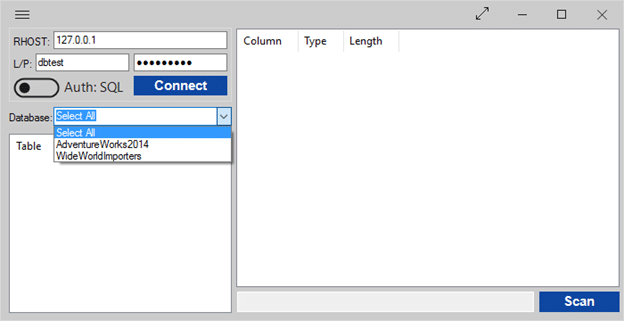
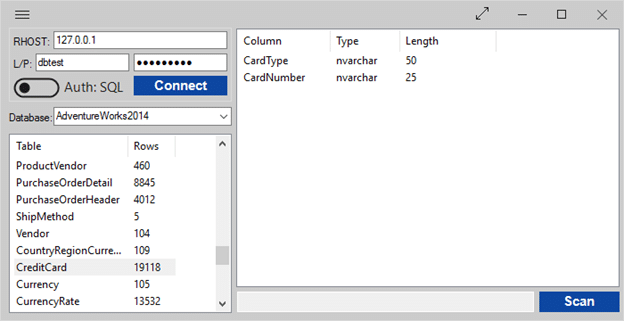
If you’d like to do targeted scanning you can narrow the focus to a specific database, table, or even column by selecting the database from the drop down, and then clicking on the table or column you’re interested in.
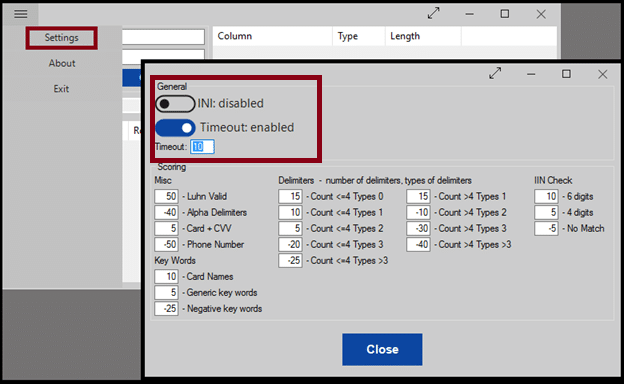
General
If you decide to customize some of the more advances settings, you may want to enable the use of an INI file so your changes persist. In order to keep scan times reasonable, you may want to enable the per column timeout and set a reasonable cap of 1 to 10 minutes. Most columns are processed within a few seconds.
Scoring
The scoring system is used to generate a confidence rating for each potential finding. The lower the number, the more likely the item is to be a false positive. This tool is a simple proof of concept, so it’s highly likely you would benefit from tuning the scoring system to your environment.
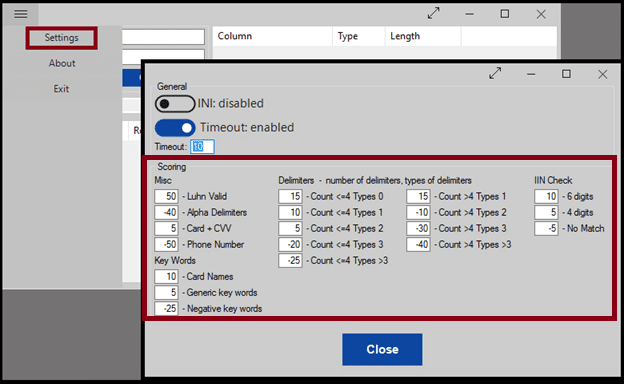
Scoring is broken up into several sections.
- Luhn Valid – By default a base score of 50 is assigned for all Luhn valid matches. Anything that fails Luhn validation is discarded.
- Alpha Delimiters – A letter exists somewhere inside the number sequence Ex: 411a1111111111111
- Card + CVV – Match is followed by 3 digits Ex: 4111111111111111 123
- Phone Number – The match looks like it could be part of a phone number Ex: 1-4111111111111111
- Keywords – The text visa, card, etc. exists in the cell containing the match Ex: visa 4111111111111111
- Negative Keywords – Triple A membership numbers “aaa” are 16 digits and Luhn valid.
- Delimiters – The number of delimiters and the types. Ex Count:4 Types:2: 411-111-111-111/1111
- IIN Check – Does match contain a known IIN
Known Issues
- The script is single threaded. Once you start a scan the GUI will become unresponsive until it completes it’s run.
- The only way to stop a scan early is to kill the application.
- dataLoc was tested exclusively on Windows 10. There may be issues with the GUI on anything older.
Feel free to submit a ticket to the GitHub repository if something doesn’t work as expected. I’d love some constructive feedback.
References
Explore More Blog Posts

Modern Adventures in Azure Privilege Escalation
Azure has been growing rapidly over the past few years As of June 2026, there were over 200 services, 897 built-in Azure RBAC roles, and 22,018 different permissions. The attack surface of Azure has also increased with this growth. There are also a number of new and updated tools that give us insight into the […]

A New Era for Offensive Security
Today, NetSPI and Synack announced a definitive agreement to merge, backed by KKR, forming the industry’s leading offensive cybersecurity platform.

Introducing EchoBench: A Human Calibrated Benchmark for Autonomous Pentesting
NetSPI introduces EchoBench, a human-calibrated benchmark for autonomous AI web app pentesting. EchoBench measures finding fidelity, difficulty-reach, OWASP breadth, and repeatability to accurately gauge AI security capabilities against real human outcomes.