
Information Security Newspaper: Very Critical Information Disclosure Vulnerability in Azure Active Directory (AD). Patch Immediately
On November 18, 2021, NetSPI Director Karl Fosaaen was featured in an article written by Octavio Mares for Information Security Newspaper. Read the full article below or online here.
This week, Microsoft reported the detection of a sensitive information leak vulnerability that affects many Azure Active Directory (AD) deployments. The flaw was tracked as CVE-2021-42306 and received a score of 8.1/10 according to the Common Vulnerability Scoring System (CVSS).
According to the report, incorrect configuration in Azure allows “Run As” credentials in the automation account to be stored in plain text, so any user with access to application registration information could access this information, including threat actors.
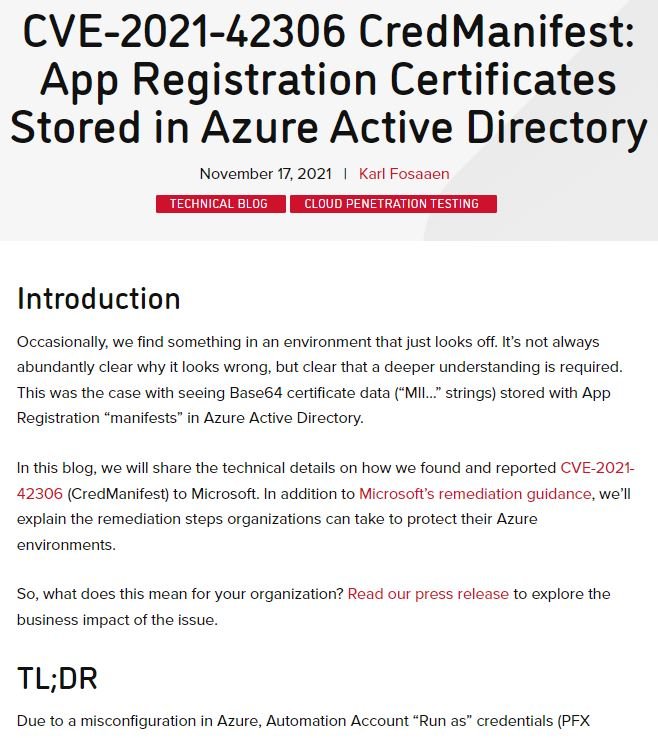
The flaw was identified by researchers at cybersecurity firm NetSPI, who mention that an attacker could exploit this condition to perform privilege escalation on any affected implementation. The risk is also present for credentials stored in key vaults and any information stored in Azure services, experts say.
Apparently, the flaw is related to the keyCredentials property, designed to configure authentication credentials for applications. Microsoft said: “Some Microsoft services incorrectly store private key data in keyCredentials while building applications on behalf of their customers. At the moment there is no evidence of malicious access to this data.”
The company notes that the vulnerability was fixed by preventing Azure services from storing private keys in plain text in keyCredentials, as well as preventing users from accessing any private key data incorrectly stored in this format: “Private keys in keyCredentials are inaccessible, which mitigates the risk associated with storing this information,” Microsoft concludes.
Microsoft also mentions that all Automation Run As accounts that were created with Azure Automation certificates between October 15, 2020 and October 15, 2021 are affected by this flaw. Azure Migrate services and customers who deployed VMware preview in the Azure disaster recovery experience with Azure Site Recovery (ASR) could also be vulnerable.
To learn more about information security risks, malware variants, vulnerabilities and information technologies, feel free to access the International Institute of Cyber Security (IICS) websites.
Explore More News

Proof Over Promises: A New Doctrine for Cybersecurity
As cyberattacks grow in frequency and sophistication, traditional assurances like contracts and certifications are no longer sufficient. Instead, vendors must actively demonstrate their security resilience through measurable and continuous validation, such as penetration testing. This proactive approach not only strengthens vendor-customer relationships but also mitigates risks in an increasingly interconnected and vulnerable digital landscape.

The Age of Promises is Over, Vendors Must Now Lead with Evidence-Based Assurances
In today’s evolving cyber threat landscape, traditional vendor assurances like contracts and periodic audits are no longer sufficient. Sam Kirkman emphasizes the need for vendors to shift from trust-based compliance to evidence-based security, where measurable and continuous validation replaces outdated promises.

NetSPI Redefines Pentesting with New User Experience
NetSPI, the global leader in modern penetration testing, today announced a new, modern user experience for the NetSPI platform, reimagining what penetration testing should feel like for today’s enterprise: focused, fast, and easy.