What Cybersecurity Actually Looks Like in 2026

TL;DR
Here are the top cybersecurity trends that are shaping the industry in 2026 and beyond:
- AI, Friend and Foe: AI is revolutionizing cybersecurity, automating tedious tasks, and enhancing efficiency. However, it also empowers attackers with tools like deepfakes and misinformation, creating new challenges for defenders.
- Cloud Security Needs Improvement: Cloud adoption continues to rise, but detection and response capabilities lag behind on-prem solutions. Advancements in cloud-native tools and AI-driven technologies are expected to bridge this gap.
- Expanding Attack Surface: The attack surface is growing rapidly due to cloud adoption, API proliferation, and AI integration. Traditional security measures struggle to keep up with this dynamic and interconnected landscape.
- Proactive Security is Essential: Resilience is the new priority. Organizations must shift from reactive defenses to visibility, prioritization, validation, and readiness to adapt to evolving threats.
- Social Engineering is on the Rise: AI is supercharging social engineering attacks, making them more sophisticated and harder to detect. Security training must evolve to focus on behavioral change and system-level defenses.
- Supply Chain Vulnerabilities: Small to mid-sized vendors are at risk of being overlooked in the supply chain and becoming major attack vectors. Visibility and transparency in dependencies are critical to preventing ecosystem-wide incidents.
- Adapting to AI Application Complexity: As AI becomes more integrated into applications, security professionals must stay agile and up to date on AI practices to address the growing complexity of systems.
Cybersecurity Trends Shaping 2026
Cybersecurity in 2026 is a whirlwind of complexity, speed, and constant change. We’re not just dealing with malicious entities using well-documented TTPs. AI is everywhere, doing both amazing and terrifying things. The places where attacks can happen? They’re multiplying. And the people trying to break in? They’re equipping attacks at the click of a prompt. We can’t keep building bigger walls and calling it a day. That approach won’t work against today’s scale and speed of threats.
What we need is resilience, the ability to bounce back.
We must adapt, because unfortunately, a bad actor is probably going to get through to your system eventually. The question that drives resilience is, what happens next?
Security leaders are stepping up to the challenges of this new reality. They’re realizing everything is connected today. One vulnerability here creates a domino effect over there. It’s this massive, tangled web of risks, but opportunities too. When you can see the whole picture, you have a better chance of staying ahead of the game.
Proactive beats reactive. Every. Single. Time.
So, what are the security experts at NetSPI seeing? We need to completely flip the script on security. Stop waiting for something bad to happen and then scrambling to fix it. Instead, we should be constantly testing, validating, and checking our defenses before someone else finds the gaps.
The shift is already happening. Many companies feel it coming and are building the kind of resilient defenses that define success in this new era. 2026 is going to reward the organizations that adapt now.
Contributing NetSPI Security Experts
 Nabil Hannan, Field CISO
  Phil Morris, Director of Security Program Operations
  Joe Evangelisto, CISO
  Sridhar Jayanthi, Chief Product & Technology Officer
 Scott Sutherland, VP Product & Research
  Kimberly Wiles, Director of AI Penetration Testing
  Karl Fosaaen, VP, Research
  Paul Ryan, Senior Director of Web App Pentesting
  Kyle Rozendaal, Managing Consultant
  Philip Young, Director of Mainframe Pentesting
AI: Your New Friend or Foe?
AI is the new electricity, and it’s powering everything, including the threats you’ll face. It’s speeding up what we do, uncovering patterns we’d miss, and automating the tedious tasks. But just as fast as it’s giving defenders superpowers, it’s handing out new weapons to attackers too.
 Joshua Weber Director of Internal Network Penetration Testing
Automation and AI will replace a ton of tedious manual work in our processes.
We are already making huge strides toward this, and ultimately, it will allow our testers to be more efficient, cover more ground, and focus on the more interesting things that provide value for our clients.
 Nabil Hannan Field CISO
AI-driven deepfakes will supercharge social engineering.
When fake content is indistinguishable from the real version, the fallout is enormous. As Nabil warns, “When cases of AI-powered misinformation and disinformation play out in higher stakes environments, internal and external trust can easily drop, and financial losses can become frequent and significant.
 Scott Sutherland VP Product & Research
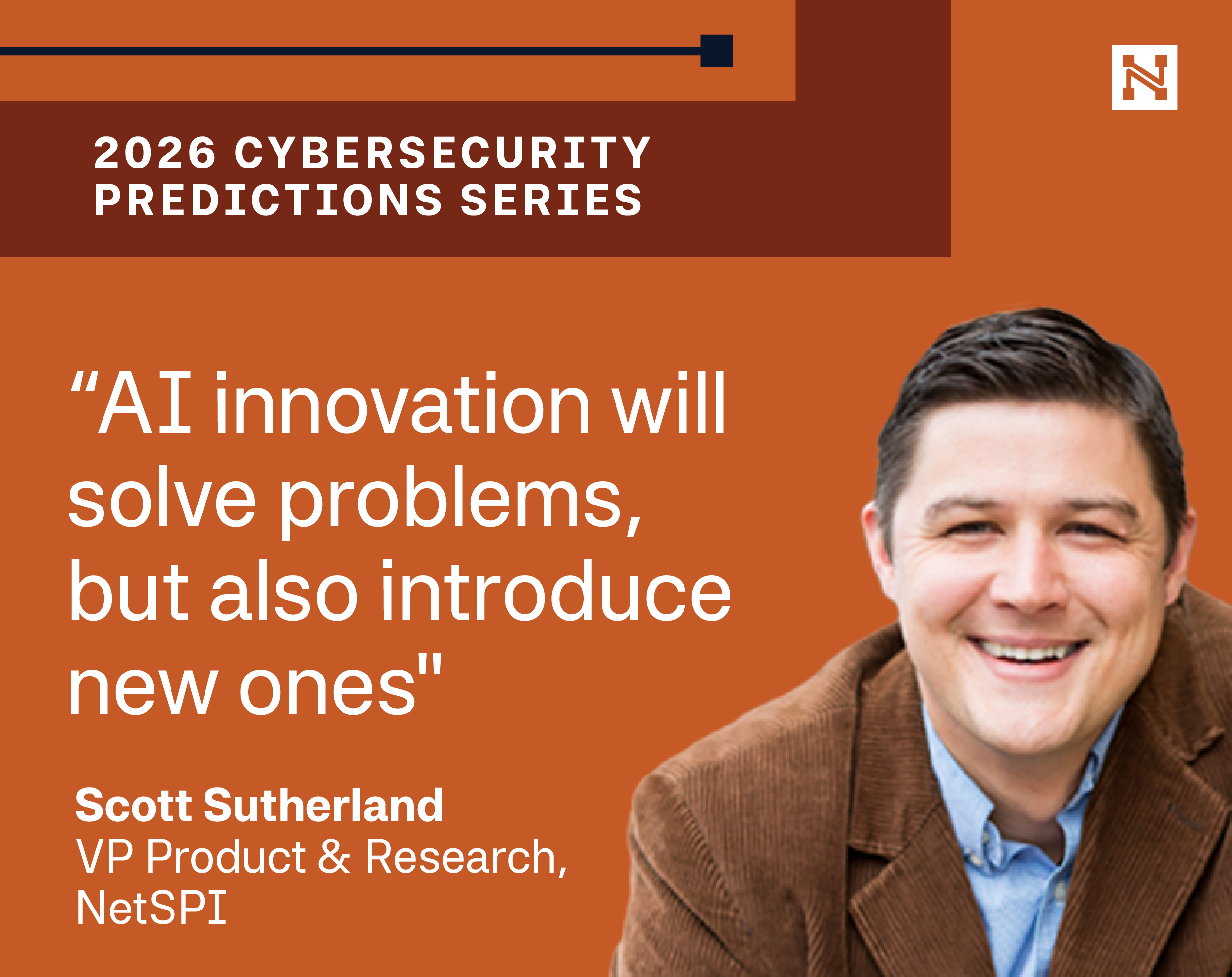
Scott sees what’s coming in AI as a double-edged sword:
“AI and automation will remain central priorities in cybersecurity through 2026, introducing both innovation and new complexity. While some organizations pursue fully autonomous systems, human expertise will remain critical to managing risks and addressing the limitations of agent-driven workflows in live environments.
Overinvestment in AI without clear, measurable outcomes will continue but taper as some AI budgets run out. Successful implementations will improve efficiency (and maybe even profits for some), but often at the cost of transparency, long-term manageability, and compliance assurance. Cybersecurity and adjacent communities like DevOps and data science will inevitably develop solutions to overcome those challenges. Those solutions will eventually drive safe, manageable, and secure autonomous systems, but expect a bumpy transition period.”
 Phil Morris Director of Security Program Operations
Phil hits on an overlooked danger: we’re giving AI access to a lot of raw, messy, and uncatalogued data.
“In just a few months, every service and software offering will have components of AI in them. As AI adoption increases, our ability to learn where it can work well and where it works badly will be proven out by experimentation. A lot of that experimentation will be the result of organizations realizing the value of their unstructured data.
Usually siloed and uncatalogued in documents, such as Optical Character Recognition (OCR) files, Confluence pages, and OneNote notebooks, will be as important – if not more so – than the transactional, structured data that they’ve built their businesses on, which typically resides in one of their many ‘systems of record.'”

What’s more?
These models are different from us.


That gap between how we think and how AI works is where today’s biggest risks are hiding. Kimberly Wiles, Director of AI Penetration Testing, underscores the need for agility, both in thought and in practice:
“As the use of AI is integrated into more features and applications, as well as the further implementation of AI infrastructure and orchestration tooling (agentic workflows, MCP, etc.), the security industry will likely need to adapt alongside the growing complexity of applications. Where currently utilized tools may be straightforward in their use cases, it is more likely that some model, AI tooling, or similar non-standard addition to current applications will sit between existing flows, requiring new solutions.
Security professionals will also need to stay up to date on AI practices to prepare for this eventual upheaval of standard practices, and to ensure they can stay flexible as we navigate new/future developments. While we likely won’t see a change in 100% of current applications and infrastructure, the change will be present enough to warrant an overall shift in the current methodology, practices, and tooling that we rely on.”
AI reshapes not only tech stacks, but also the skills & mindset required to defend them
As cloud platforms sprawl and become more complex, that gap between threat and detection could make or break your security posture. And all it takes is an employee “helping” the business by pasting something sensitive into an AI tool. Joe Evangelisto, CISO, doesn’t mince words:
“We will see more ‘self-inflicted’ data leaks as employees paste sensitive information into public models or sync project files to unmanaged AI tools and agents. These aren’t classic attacks, they’re quiet leaks that erode customer trust and create significant regulatory headaches. Without a security-first culture, AI becomes shadow IT at scale.”
-
– Joe Evangelisto, NetSPI CISO

Defending the cloud is equally turbulent.
 Karl Fosaaen VP, Research
Karl notes that while cloud adoption keeps rising, security is struggling to keep pace.
“While there have been rumblings about organizations backing out of cloud deployments to bring things back to on-prem, we have continued to see an increase in cloud adoption year over year. Additionally, the cloud native detection and response tooling space has continued to improve. Expanding upon the well-established Cloud Security Posture Management (CSPM) market, we have seen lots of growth in cloud acronym space in the last few years. For example – CNAPP, CWPP, CIEM, and SSPM.
While these additional technologies have helped advance in the cloud security space, there is a long way to go to catch up with on-prem detection and response. We have noted a general lack of visibility on cloud specific attacks during recent detective controls testing engagements, and this lack of visibility can lead to major impacts.”
Karl predicts meaningful progress ahead:
“In the following year, I anticipate seeing advancements in cloud technologies (likely via AI) pushing much-needed improvements to cloud detection and response capabilities.”
Today’s Attack Surface is Bigger, Faster, and More Complex
Attack surfaces used to be maps you could mostly follow. But not anymore. Between cloud everything, API proliferation, and AI folding itself into every tool and workflow, your attack surface is now a moving target. Huge, fast, and unpredictable.
![]() Sridhar Jayanthi Chief Product & Technology Officer
Sridhar Jayanthi Chief Product & Technology Officer
“The single most significant challenge for security leaders will be managing an attack surface that is not just expanding but is evolving at an unprecedented pace.” Forget old routines. Scanning your network once a quarter isn’t going to cut it.
“The critical vulnerabilities will not be found in quarterly network scans but within the complex logic of web applications and the sprawling, interconnected services of the cloud.”
API growth? It’s going vertical. Paul Ryan, Senior Director of Web Application Penetration Testing, says it outright:
“API’s growth is tethered to AI’s growth. Therefore, whether it is traditional systems or generative and agentic AI systems, the massive number of APIs for all of these will continue to grow exponentially.”
Every new API is another route in, or out, of your organization, and they’re multiplying by the day.
Stop Waiting. Start Testing.
 Resilience Isn’t Magic. It’s Routine. Aaron Shilts, President & CEO
“Security is a discipline of readiness, not reaction. True resilience is built on a foundation of people, process, and continuous validation, not just an accumulation of tools.”
- Stop waiting for things to break: Your future success depends on probing for weaknesses before anyone else does.
- Proactive testing wins: Constant testing of everything, from networks to apps to your people and processes.
 Scattershot Approach to Pentesting is Fading Kyle Rozendaal, Managing Consultant
“I think we will start seeing companies trend towards objective and identity-based pentesting. Rather than taking a broad-swath approach to network and application testing, I think we will see much more scenario-based testing that focuses on current CVEs, Identity-Based Models, and penetration testing that has a specific scenario and target in mind.”
People, Pressure, and the Art of Social Engineering
 Patrick Sayler Director of Social Engineering
As much as we talk about technology, attackers usually care more about people than firewalls. Social engineering, a.k.a. the art of tricking humans, has never been more accessible because AI has supercharged it.
“Social engineering phone calls will continue to dominate breach headlines as they fall into one of the biggest detection blind spots for both people and organizations.”
Email threats? At least you can flag those.
Phone scams? They’re easier to slip past you.
“These solutions simply do not exist for voice-based attacks. Malicious calls can only be reacted to after the fact, which already gives the attacker a head start.”
This is forcing a shakeup in security training, too. Philip Young, Director of Mainframe Pentesting:
“Conventional wisdom has always held that cybersecurity awareness training was paramount to helping fight back against social engineering. However, a 2025 study by the University of Chicago and the University of California, San Diego, has shown that this type of training has little benefit and, in some cases, has a negative impact. With threat actors shifting to using LLMs to scale their phishing operations, and the continued rise of social engineering attacks against authentication providers, it is clear that the current training model is no longer sufficient.
Organizations will move away from shaming-based approaches towards a lighter touch. The shift will emphasize behavioral change through targeted interventions, not consequences, though industry pressure and the desire for metrics may push some organizations back toward more visible penalties. Alongside this, organizations will increasingly harden the ingress procedures for users, shifting investment away from the assumption that users are the front line against these types of attacks and toward the systems they interact with.”It’s not about fear or frustration; it’s about education that sticks.
– Philip Young, NetSPI
Supply Chain Vulnerabilities
Supply chain trust, the newest attack vectors come from the least expected places.
“We can expect to see outsized supply chain compromises that ripple across entire ecosystems. These won’t necessarily originate from headline vendors, but from smaller firms that plug into larger platforms, such as niche connectors for CRMs, ERPs, and CI/CD pipelines.”
- Joe Evangelisto, NetSPI CISO
One small overlooked connection can become a massive, highly public breach.
Ready or Not, Let’s Adapt to the Future Together
What’s ahead? More complexity. More connections. More chaos… and more opportunity, but only for those who can see through the fog, practice adaptability, and move fast toward resolutions. The big lesson from NetSPI’s experts: don’t stand still. Build resilience into your culture, continuously test and improve, and always remember: it’s not “if an attack will happen,” but “when.”
If you want to increase your digital resilience this year and beyond, start embracing a proactive security approach now. Flip the script on point-in-time testing for an ongoing approach to security testing. The next big breach will happen, but it doesn’t have to be yours. Let’s advance your security program together. Contact us.
Authors:

Explore More Blog Posts

Q1 2026 Critical Vulnerability Roundup: Mitigating Risk
Discover the top critical vulnerabilities of 2026 identified by Team NetSPI and learn how proactive security measures can protect your strategic business initiatives.
Anthropic’s Mythos Announcement: What it Means for Security Teams
Anthropic's Mythos accelerates automated vulnerability discovery. Read how to mitigate risk with custom benchmarks and human verification in your workflows.

Regulatory-Ready Security: Ensuring FCC Compliance for Routers
Last week, the FCC released a major update to the “Covered List”, officially adding foreign-produced consumer-grade routers to the registry of equipment deemed a threat to national security. This declaration was in part due to the discovery of backdoors in select routers that used standard apps in an attack chain to create a backdoor into seemingly protected networks.